
Estimated reading time: 7 minutes
You didn’t change anything. Your ads were approved. Your landing page hasn’t been touched in months. And yet your Google Ads account is suspended — or one of your previously-approved ads just got flagged out of nowhere.
If that sounds familiar, you’re not imagining it. Something has genuinely changed in how Google enforces its advertising policies in 2026, and it’s catching a different kind of advertiser than it used to: not just the rule-breakers, but businesses that thought they were already compliant.
Here’s what’s actually happening, why it’s happening now, and what you need to know before you touch your appeal.
What’s actually changed in 2026
Google’s enforcement hasn’t just gotten stricter — it’s gotten smarter, and that distinction matters more than it sounds.
1. Enforcement now looks at patterns, not single ads
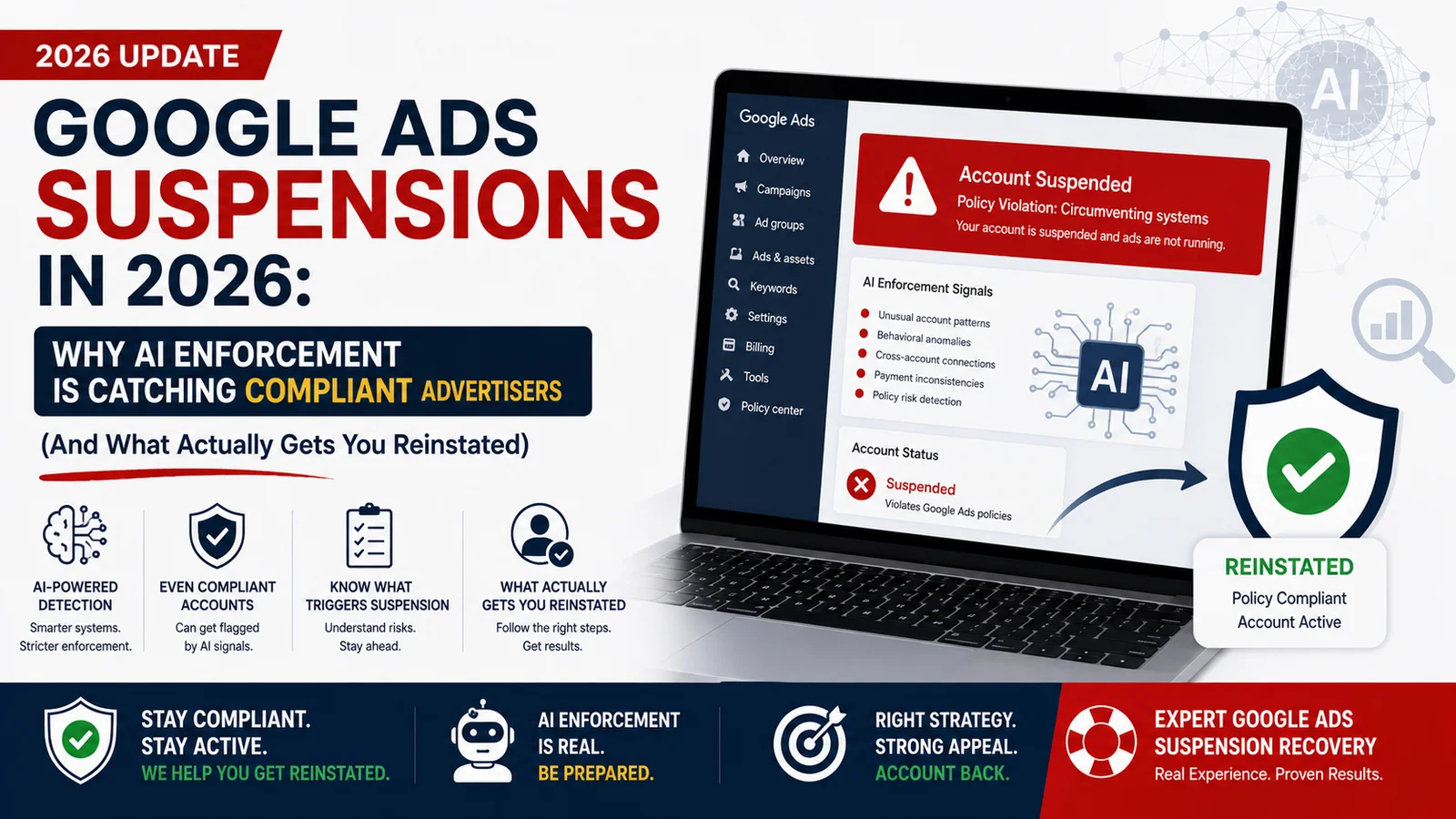
In previous years, a policy violation was largely evaluated ad by ad. Fix the one flagged ad, move on. In 2026, Google’s systems increasingly evaluate behavior over time — meaning if you fix one ad but keep submitting similar claims across other ads or campaigns, the system can read that as a deliberate pattern rather than an isolated mistake. That distinction is significant, because Google treats patterns of behavior far more severely than one-off violations, and repeated patterns are what typically escalate a warning into a suspension rather than a simple disapproval.
Why this matters for recovery: if your appeal only addresses the single ad or page Google flagged, without looking at whether the same issue exists elsewhere on your account or website, you’re leaving the actual pattern in place — and that’s a common reason appeals get rejected a second time.
2. AI-powered review is generating more false positives, not fewer
Google has been rolling out AI-driven creative and asset review across campaign types, including asset-level review for Performance Max campaigns. The upside is that a single flagged asset no longer necessarily pauses your entire campaign. The downside — and this is the part most advertisers aren’t prepared for — is that automated, AI-driven review introduces its own error rate. Legitimate, policy-compliant assets can get caught by a system that’s pattern-matching against risk signals rather than reading context the way a human reviewer would.
This is a big part of why so many advertisers are describing suspensions that make no sense to them. The system isn’t necessarily wrong about seeing a signal — it’s wrong about what that signal means for a genuinely compliant business.
3. The three-strikes escalation model is running quietly in the background
Google’s enforcement structure typically escalates through warnings, into temporary restrictions, and finally into account-level suspension, with repeated or unresolved violations compounding faster than a single incident would. If your account has picked up policy warnings or ad disapprovals in the past that were never fully resolved — even months ago — those can still be part of the picture Google’s system is weighing today. This is exactly why a suspension often feels sudden from the advertiser’s side but isn’t sudden at all from Google’s.
4. Enforcement now reaches further than your ad copy
Google’s review process in 2026 continues to expand beyond the ad itself. Your website, your business information, your billing history, and accounts linked to yours — including Merchant Center connections or shared manager accounts — can all factor into a single account’s compliance picture. A clean ad running from a website with weak trust signals, inconsistent business details, or a shared payment method linked to a previously suspended account is still a compliance risk in Google’s eyes, even if the ad copy itself is perfect.
5. If you advertise in this exact niche, read this part twice
Here’s a detail that doesn’t get talked about enough: Google has been more aggressive about applying its Limited Ad Serving policy to accounts targeting Google-related keyword phrases — things like “Google Ads agency” or “Google Ads account suspended.” If you or an agency you work with runs paid campaigns using these kinds of terms, that campaign itself carries elevated suspension risk under current enforcement, independent of anything else on the account.
What this means if your account is already suspended
None of the above changes the fundamentals of recovery — it just changes what a thorough review needs to cover before you appeal again.
A 2026-appropriate compliance review should look at:
- The specific ad or asset Google flagged — not just what it says, but why it might have triggered a pattern-matching signal.
- Every other ad, asset, and landing page using similar language or claims — because if the pattern exists elsewhere, Google’s system may still see it even after you fix the one flagged item.
- Your account’s warning and disapproval history — including issues that seemed resolved months ago.
- Linked accounts and shared infrastructure — Merchant Center, manager accounts, shared billing profiles.
- Website trust signals — business information consistency, legal pages, and landing page transparency, which remain one of the most common root causes behind Unacceptable Business Practices and Circumventing Systems suspensions.
Skipping any of these before resubmitting an appeal is one of the most common reasons a second (or third) appeal fails even after real effort has gone into fixing the “obvious” issue.
A quick, real example of pattern-based enforcement in practice
We’ve seen this play out with clients directly. In one case, a business had a single disapproved ad for an exaggerated pricing claim. They rewrote that one ad and appealed — rejected again. The reason: three other active ads across two campaigns used a near-identical version of the same claim. Nothing had technically changed from Google’s system’s point of view, because the pattern was still live. Once every instance of the claim was identified and corrected — not just the one Google had flagged — the account was reinstated. This is the pattern-over-single-violation shift in action, and it’s becoming the norm rather than the exception.
Frequently Asked Questions
Is Google Ads really suspending more accounts in 2026 than before? Multiple industry trackers and agency reports have noted rising suspension activity in 2026, largely attributed to more sophisticated AI-based detection systems being applied across more campaign types, including Performance Max. Google has not published exact suspension volumes publicly.
If Google’s AI review has more false positives, can I argue that in my appeal? You can explain your position, but appeals succeed when they’re supported by evidence and corrected root causes — not by arguing the system made a mistake. If you believe you were flagged incorrectly, the strongest appeal still addresses every place the flagged pattern could plausibly appear, not just the one instance Google cited.
Does fixing the one ad Google flagged usually work? Sometimes, but increasingly not on its own. Because enforcement now weighs patterns across your account, the same issue existing elsewhere — even in ads that haven’t been flagged yet — can still keep the account under review.
Can my website really affect a suspension that seems to be about my ads? Yes. Google’s review can extend to your website’s business information, trust signals, and legal pages, independent of what your ad copy says. This is one of the most common root causes behind Unacceptable Business Practices and Circumventing Systems suspensions specifically.
Should I run ads targeting keywords like “Google Ads account suspended” or “Google Ads agency”? Do so carefully. Google has increased enforcement of its Limited Ad Serving policy specifically around Google-related keyword targeting, which adds suspension risk to that kind of campaign regardless of how the rest of the account is set up.
How long does reinstatement typically take once the real cause is fixed? It varies by suspension type and complexity, but cases where the underlying compliance issues are identified and properly addressed before resubmission are generally reviewed faster than repeated appeals that don’t change the underlying pattern.
If your account was already suspended — or an ad just got flagged out of nowhere
This shift toward AI-driven, pattern-based enforcement is exactly why we don’t recommend resubmitting an appeal based on a guess. Before you appeal again, it’s worth understanding whether the issue Google flagged is isolated — or whether it’s a pattern that’s still live somewhere else in your account or on your website.
We review your account, your website, and the pattern behind the flag — not just the single ad or page Google pointed to — before recommending your next step.
Request a Free Account Review → Chat on WhatsApp → Call: +91-9871530594
Written by Rohit Kumar, Google Ads Certified specialist and founder of AdsSuspensionRecovery.com. 8+ years of experience managing Google Ads accounts and suspension recovery cases across India and internationally.


