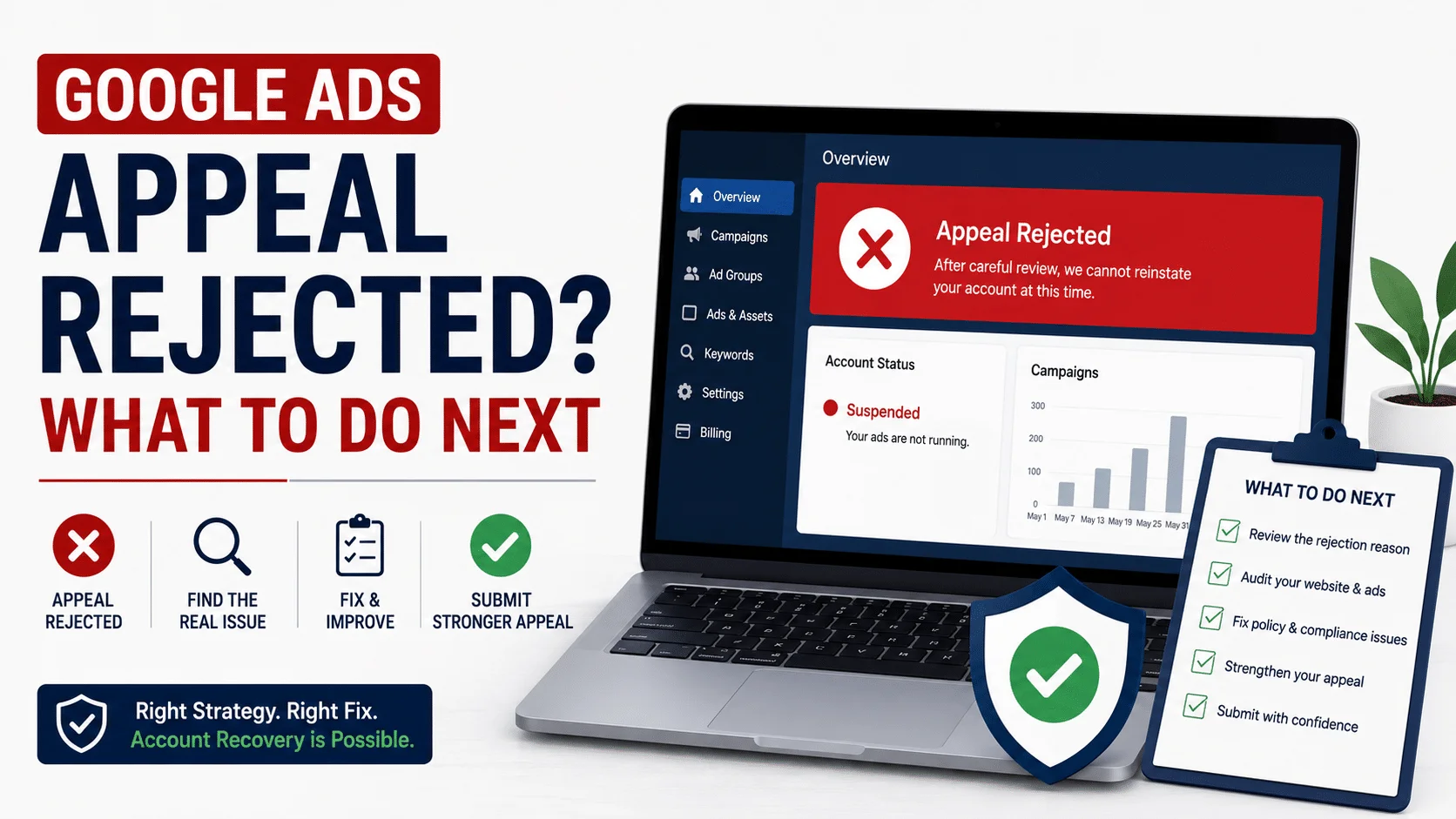
If your Google Ads appeal was rejected, you’re not alone. Many advertisers assume that correcting a few website issues or explaining their situation is enough to restore a suspended account. However, Google’s review process is often more comprehensive than most businesses expect.
Receiving another rejection can be frustrating, especially when your advertising campaigns are paused, leads have stopped, and you don’t know what else needs to change. The notification usually provides limited information, leaving you to determine what prevented the appeal from succeeding.
The good news is that a rejected appeal doesn’t always mean your account can never be reviewed again. Instead, it often indicates that Google’s reviewers were not satisfied that the underlying compliance concerns had been addressed.
In this guide, you’ll learn why Google Ads appeals are rejected, the most common mistakes advertisers make, and what you should review before submitting another appeal.
Why Google Ads Appeals Rejected
Many advertisers focus only on the suspension notice. However, Google’s review generally considers your website, business information, account history, payment profile, landing pages, and previous policy compliance.
If these areas still contain unresolved issues, your appeal may be unsuccessful.
Some common reasons include:
- Website compliance issues remain unresolved.
- Business information is inconsistent.
- Landing pages still don’t meet policy expectations.
- Payment or verification issues haven’t been addressed.
- The appeal provides little evidence of corrective action.
Instead of asking Google to reconsider the decision without demonstrating meaningful improvements, focus on identifying and resolving the underlying issues first.
Common Mistakes After an Google Ads Appeal Is Rejected
Appealing Repeatedly Without Making Changes
Submitting the same appeal multiple times rarely changes the outcome.
Instead, perform a complete review of your website and account before requesting another review.
Making Random Website Changes
Some businesses redesign their entire website after a rejection.
However, changing pages without understanding the real issue often delays progress rather than improving it.
Opening a New Google Ads Account
Creating another account after a suspension does not resolve the original compliance concerns.
Google expects advertisers to address the existing suspension through the appropriate review process.
Using Generic Appeal Templates
Copying appeal letters from online forums usually provides little value because every suspension is different.
A stronger appeal explains the specific changes made to your own website and business.
What You Should Review Before Appealing Again
Before submitting another appeal, review the following areas carefully:
- Business information
- Website transparency
- Privacy Policy
- Terms and Conditions
- Contact details
- Landing pages
- Technical website issues
- Payment profile
- Advertiser Verification
- Previous policy warnings
A structured review often identifies issues that were overlooked during the first appeal.
Build Evidence Before You Appeal
Rather than making changes without documentation, keep a record of:
- Website updates
- Policy pages added
- Business information corrected
- Technical fixes completed
- Landing pages improved
When appropriate, refer to these improvements in your appeal so Google’s reviewers understand the actions you’ve taken.
Don’t Guess the Cause of the Suspension
One of the biggest mistakes advertisers make is assuming they know exactly why the account was suspended.
Google rarely identifies the specific trigger. Therefore, avoid focusing on one issue while ignoring the rest of your website and account.
Instead, review your entire advertising ecosystem before requesting another review.
When Should You Seek Professional Help?
If your appeal has already been rejected and you’re unsure what to review next, a second opinion may help.
An experienced compliance review can identify website, technical, business identity, or payment issues that are easy to overlook when reviewing your own account.
While no consultant can guarantee account reinstatement, identifying genuine compliance issues before another appeal generally provides a stronger foundation than relying on guesswork.
Read the Complete Circumventing Systems Recovery Guide
If your Google Ads account was suspended for Circumventing Systems, this article explains only one part of the recovery process.
Our complete guide covers:
- Why Circumventing Systems suspensions happen
- Common website compliance issues
- Business identity reviews
- Payment considerations
- Appeal preparation
- Practical recovery strategies
Read the complete guide here:
https://adssuspensionrecovery.com/google-ads-suspended-circumventing-systems/
Frequently Asked Questions
Can I submit another Google Ads appeal after it is rejected?
Yes. However, it’s usually best to address any unresolved compliance issues before submitting another appeal.
How long should I wait before appealing again?
There is no fixed waiting period. Focus on completing meaningful improvements rather than appealing immediately.
Does changing my website guarantee approval?
No. Website improvements may strengthen your overall compliance profile, but Google evaluates multiple factors during its review.
Should I create a new Google Ads account?
Generally, no. If your original account has been suspended, resolving the underlying issues is usually the appropriate next step.
Conclusion
A rejected Google Ads appeal doesn’t necessarily mean the end of the recovery process. More often, it indicates that additional work is needed before Google is satisfied that the relevant compliance concerns have been addressed.
Take the time to review your website, business information, landing pages, technical setup, and account history. Once you’ve made meaningful improvements, you’ll be in a better position to submit a well-supported appeal.
If your suspension relates to Circumventing Systems, our detailed recovery guide provides a structured approach to reviewing your account before requesting another review from Google.
Read Official Google Circumventing Policy – Click here