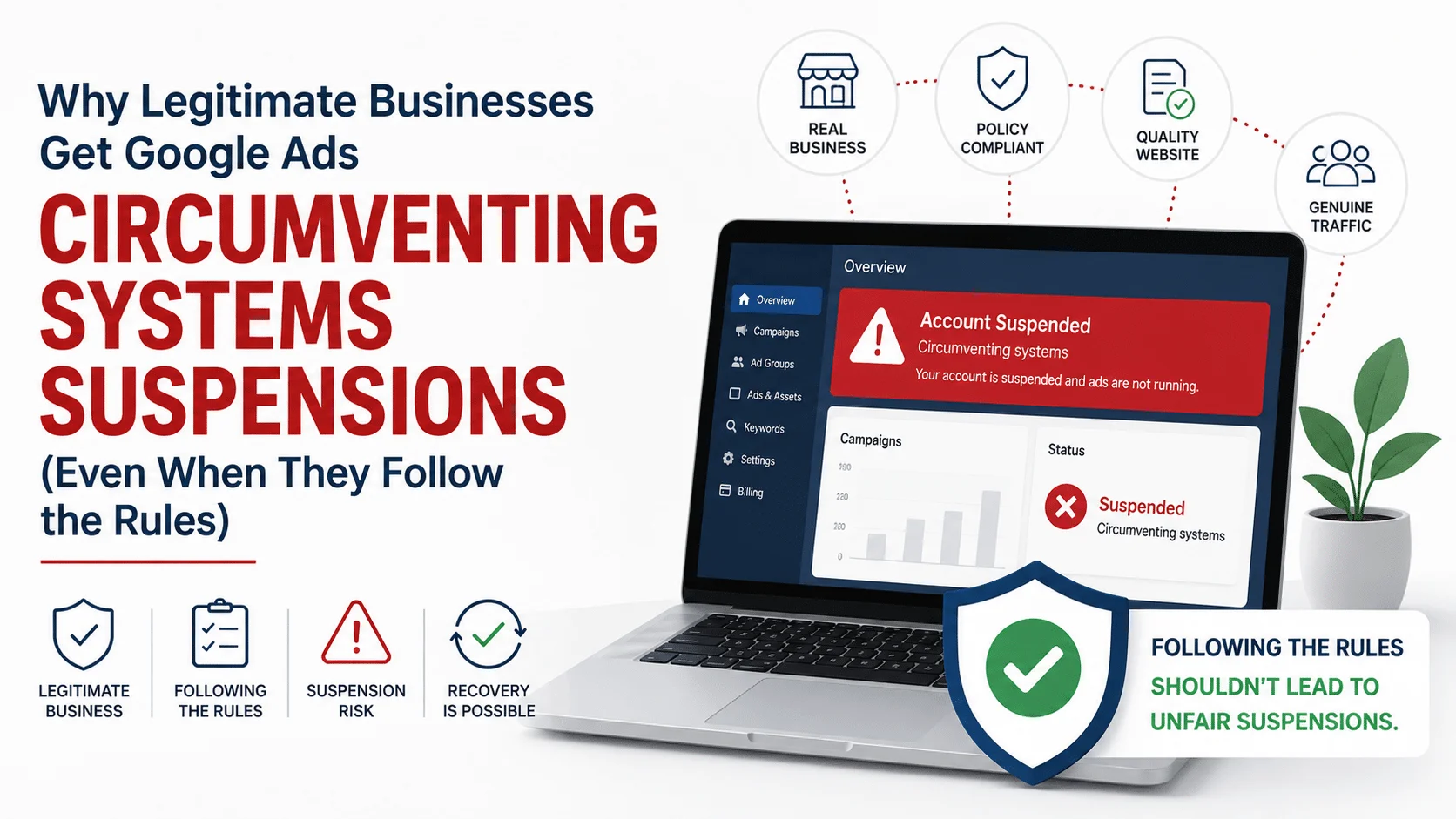
Receiving a Google Ads Circumventing Systems suspension can feel confusing, especially when you’ve never intentionally violated Google’s advertising policies.
Many advertisers assume this type of suspension only affects scammers or businesses trying to bypass Google’s rules. However, that’s not always the case.
Every month, legitimate businesses contact us after their Google Ads account is suspended without any obvious explanation. Their websites look professional, their products are genuine, and they’ve invested significant time and money into building their business. Yet they still receive the same message:
“Your Google Ads account has been suspended for Circumventing Systems.”
The biggest challenge is that Google rarely identifies one specific reason. Instead, advertisers are left wondering whether the issue relates to their website, payment profile, business information, landing pages, or something else entirely.
In this guide, we’ll explain why legitimate businesses can receive this suspension, the trust signals Google may review, and the practical steps you should take before submitting another appeal.
Can Legitimate Businesses Really Receive a Circumventing Systems Suspension?
Yes.
A Circumventing Systems suspension does not automatically mean your business intentionally tried to deceive Google.
Google’s policy is designed to prevent advertisers from bypassing its review systems or advertising policies. However, automated reviews and manual investigations can also identify combinations of trust or compliance issues that reduce confidence in an advertiser.
For example, a legitimate business may have:
- Inconsistent business information
- Missing legal pages
- Website transparency issues
- Payment profile inconsistencies
- Broken landing pages
- Previous policy history
- Incomplete advertiser verification
Individually, these issues may appear minor. However, when several occur together, they can contribute to a broader compliance concern.
Why Google Doesn’t Tell You the Exact Reason
One of the most frustrating parts of a Circumventing Systems suspension is the lack of detailed feedback.
Unlike an ad disapproval, where Google often specifies the affected advertisement or landing page, account suspensions typically include only a general reference to the relevant policy.
Google intentionally provides limited information to help protect its enforcement systems and reduce attempts to bypass policy reviews.
As a result, advertisers need to investigate their own account, website, and business information to identify potential compliance issues before submitting another appeal.
Trust Is Often More Important Than One Individual Mistake
Many advertisers spend hours trying to identify one specific error.
However, a Circumventing Systems suspension is often better understood as an overall trust review rather than a single policy violation.
Google may evaluate areas such as:
- Website transparency
- Business identity
- Landing page experience
- Billing information
- Account history
- Advertiser verification
- Technical implementation
Rather than focusing on one page, consider how your entire business appears from Google’s perspective.
Five Signs Your Website May Need a Compliance Review
1. Your Business Information Isn’t Consistent
Your company name, address, phone number, and email should remain consistent wherever they appear.
Differences between your website, Google Ads account, payment profile, and Google Business Profile can create unnecessary confusion.
2. Important Policy Pages Are Missing
Visitors should easily find pages such as:
- Privacy Policy
- Terms and Conditions
- Refund Policy (where applicable)
- Contact Information
These pages demonstrate transparency and help users understand how your business operates.
3. Landing Pages Don’t Match Your Advertisements
Every advertisement should lead users to a relevant page that accurately reflects the offer.
Broken links, outdated promotions, or misleading content reduce trust.
4. Your Website Has Technical Issues
Technical problems can affect both user experience and Google’s review process.
Examples include:
- Redirect loops
- HTTPS errors
- Slow-loading pages
- Broken links
- Mobile usability issues
5. You Appealed Before Reviewing Your Website
Many advertisers submit an appeal immediately after suspension.
However, appealing before investigating potential compliance issues often results in another rejection.
Instead, complete a structured review first.
What Should You Do Next?
If your account has been suspended, avoid making random website changes or opening another Google Ads account.
Instead:
- Review your entire website.
- Verify your business information.
- Check your payment profile.
- Inspect your landing pages.
- Complete advertiser verification if required.
- Document any changes before appealing.
Taking a structured approach is usually more effective than relying on guesswork.
Read the Complete Recovery Guide
If your account has already been suspended for Google Ads Circumventing Systems, this article is only the starting point.
Our comprehensive recovery guide explains:
- Common suspension triggers
- Website compliance reviews
- Business identity checks
- Appeal preparation
- Frequently asked questions
- Practical recovery strategies
👉 Read the complete guide here:
https://adssuspensionrecovery.com/google-ads-suspended-circumventing-systems/
Conclusion
A Circumventing Systems suspension doesn’t always indicate intentional wrongdoing. In many situations, legitimate businesses encounter this policy because Google identifies a combination of trust or compliance concerns rather than a single obvious violation.
Before submitting another appeal, take the time to review your website, business information, landing pages, and account history. A careful, evidence-based review can help you identify areas for improvement and prepare a stronger appeal.
If you need help understanding your suspension, our detailed recovery guide provides a step-by-step framework to review your account before contacting Google again.
Read Official Circumventing Systems Policy – https://support.google.com/adspolicy/answer/15938075?hl=en