

“Your account violated the circumventing systems policy.” If Google Ads showed you that exact line, you’re dealing with one of the most serious — and most confusing — suspension types on the platform. Confusing, because Google rarely tells you which specific behavior triggered it. Serious, because this policy sits in Google’s highest enforcement category.
This guide breaks down the circumventing systems policy in Google’s own words, covers every documented trigger — cloaking, multiple account abuse, and advertiser verification fraud — and explains exactly what a strong appeal needs to include.
What Is the Circumventing Systems Policy?
The circumventing systems policy prohibits advertisers from trying to trick or bypass Google’s ad review process, through their ads, their content, or their website. Google states this plainly: ads across its network need to be useful, varied, relevant, and safe for users, and any attempt to work around the systems that enforce that isn’t allowed.
Google treats every circumventing systems policy violation as egregious. In Google’s own definition, an egregious violation is serious enough that it’s unlawful or poses real harm to users. That classification carries three practical consequences you need to understand before you do anything else:
- No warning stage. Google suspends the account the moment it detects a violation.
- Wide review scope. Google’s review can pull from your ad, your website, your accounts, and third-party sources — not just the ad that got flagged.
- No return, by default. Google states you won’t be allowed to advertise on that account again, unless your appeal succeeds.

The Three Behaviors Covered Under This Policy
Google’s documentation groups the circumventing systems policy into three distinct categories. Your suspension almost certainly falls into one of them — knowing which one changes what your appeal needs to prove.
1. Cloaking
Cloaking means showing different content to Google than you show to real visitors, specifically to hide something that breaks Google Ads policy. Google gives concrete examples: showing a policy-compliant landing page to Google’s crawler while showing something different to users, using a pop-up that blocks Google from reading your actual page, or using click trackers to redirect people somewhere Google never reviewed.
Not every content variation counts as cloaking. Google explicitly allows showing different content for language, special offers, geography, or slow internet connections — as long as the underlying product or service stays the same for everyone.
2. Multiple Account Abuse
This covers creating new Google Ads accounts after a suspension specifically to keep running content that already broke the rules. Google’s own examples range from a single advertiser reopening accounts after suspension to organized rings running dozens of accounts for a single scam.
3. Advertiser Verification Fraud
This covers submitting false or fraudulent information during Google’s advertiser verification programs — a fake government ID, a falsified business document, or misrepresented ownership information.
We break down documentation requirements for proving you’re clear of each of these three categories in our full Circumventing Systems recovery guide.
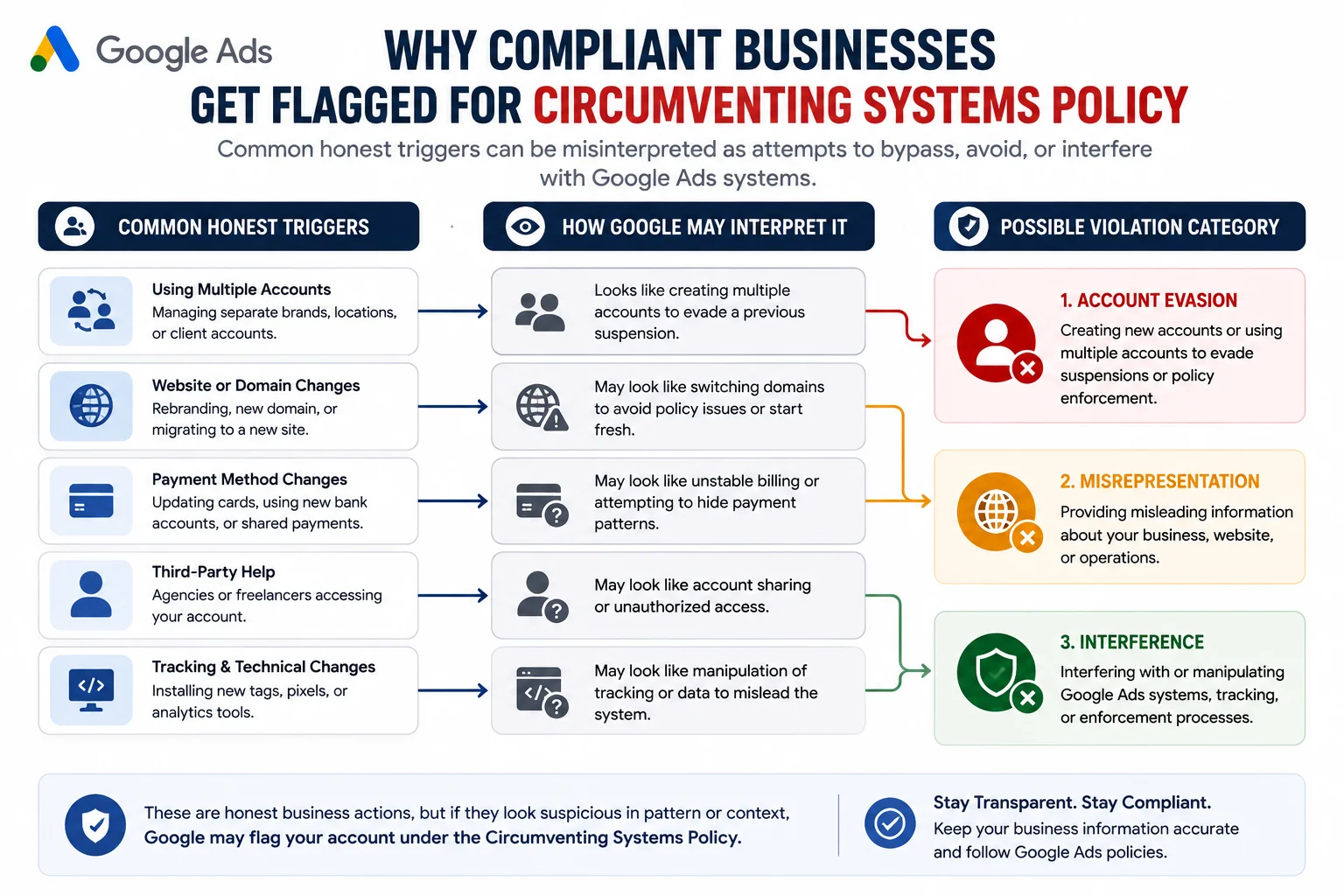
Why Compliant Advertisers Still Get Flagged
Google’s suspension notice for this policy rarely specifies which of the three categories applies to your account. That ambiguity is exactly why so many honest advertisers get caught here. A few patterns show up repeatedly:
- Accidental cloaking from a hacked site. Malware can inject cloaking scripts into a legitimate website without the owner knowing. Google explicitly recommends running a Safe Browsing check for exactly this reason.
- Uncertified click trackers. Using a click-tracking tool that isn’t on Google’s certified list can look identical to cloaking from Google’s side, even with no intent to deceive.
- Agency account sprawl. If an agency manages several client accounts and one gets suspended, the other linked accounts can get swept into a multiple-account-abuse review, even when each client is a separate, legitimate business.
- Minor document mismatches. A business document with an outdated address or a slightly different legal name than your ad account can register as inconsistent information during advertiser verification.

How to Appeal a Circumventing Systems Policy Suspension
Google’s own appeal guidance is specific to each of the three categories, and using the right one matters.
If You Were Flagged for Cloaking
Google recommends confirming your website shows the same content to Google as it shows to visitors, making sure Google’s crawlers can reach every page, switching to a Google-certified click tracker, and running a security check in case your site was compromised. In your appeal, explain specifically why the content differed — if it was a mistake, describe the steps you took to fix it, such as removing a redirect or getting certified to advertise restricted content.
If You Were Flagged for Multiple Account Abuse
Google recommends avoiding bulk account creation, connecting every account to a real, verifiable business, using a trusted payment method, and resolving any other suspended accounts you’re linked to before you appeal this one. If you work with an agency, loop them in — they may be able to explain a connection you weren’t aware of.
If You Were Flagged for Advertiser Verification
Google’s guidance here is narrow but important: submit accurate, unmodified government and business documents. If a mistake caused a mismatch, explain plainly what happened and correct the documentation before resubmitting.
Across All Three, These Additions Help
- Match your appeal to the right category. A cloaking-focused appeal won’t help a verification-fraud suspension, and vice versa — Google’s own guidance branches by category for a reason.
- Timestamp your fix. Screenshots or archive links proving you fixed the issue before appealing carry more weight than a written explanation alone.
- Stay factual. Google asks advertisers to be thorough, accurate, and honest — evidence-based appeals consistently outperform argumentative ones.
- Never open a new account while suspended. Google states this directly: doing so is itself a multiple-account-abuse violation, even if your original suspension was a mistake.
For the complete process we use with clients — account history review, website audit, and appeal preparation matched to your specific violation type — see our Circumventing Systems recovery guide or request a free account review.
Frequently Asked Questions About the Circumventing Systems Policy
What does it mean if my account violated the circumventing systems policy? It means Google’s review found evidence that your ads, website, or account tried to trick or bypass its ad review process — through cloaking, creating new accounts after a suspension, or submitting false verification information. Google’s notice usually doesn’t specify which of the three applies, so reviewing all three is the safest first step.
Why was I suspended with no warning? Google classifies every circumventing systems violation as egregious, and its documentation states egregious violations are suspended on detection, without a prior warning stage.
Can a Google Ads account suspended for circumventing systems be reinstated? Yes, but only in what Google calls “compelling circumstances, and when there is good reason.” A specific, evidence-backed appeal matched to the right violation category has a meaningfully better chance than a generic resubmission.
Is cloaking always intentional? No. Google itself notes that hacked websites can have cloaking scripts injected without the owner’s knowledge, which is why running a security scan is part of its own recommended fix.
I run an agency — can another client’s suspension affect my other accounts? Yes, potentially. Google’s multiple-account-abuse review can consider linked accounts, so a suspension tied to one client can prompt scrutiny of others sharing infrastructure, payment methods, or ownership signals.
What’s the difference between circumventing systems and abusing the ad network? Circumventing systems is one specific violation type under Google’s broader Abusing the ad network umbrella, which also covers evasive ad content and other attempts to interfere with Google’s advertising systems.
Where can I read Google’s official policy myself? Directly on Google’s Advertising Policies Help Center: the Circumventing Systems policy, the related Abusing the ad network policy, and the suspended accounts and appeals overview.
Official Google Sources on the Circumventing Systems Policy
- Circumventing Systems policy — Google Ads Advertising Policies Help
- Abusing the ad network policy — Advertising Policies Help
- Suspended Google Ads accounts overview and appeals — Google Ads Help
- Advertiser verification requirements — Advertising Policies Help
- Google-certified click trackers — Google Ads Help
- Google Safe Browsing site check — Google Transparency Report
Get Help With Your Circumventing Systems Policy Suspension
A circumventing systems suspension almost never comes with a clear explanation, which is exactly why guessing at the cause before you appeal is so risky. The three violation categories need three different kinds of evidence, and matching the wrong one to your appeal can cost you a second rejection.
We review your account, your website, and your linked accounts against all three categories before recommending your next step. Read our complete Circumventing Systems recovery guide for the full walkthrough, or get a second opinion on your specific case.
Request a Free Account Review →
Written by Rohit Kumar, Google Ads Certified specialist and founder of AdsSuspensionRecovery.com. 8+ years of experience managing Google Ads accounts and suspension recovery cases across India and internationally.


