
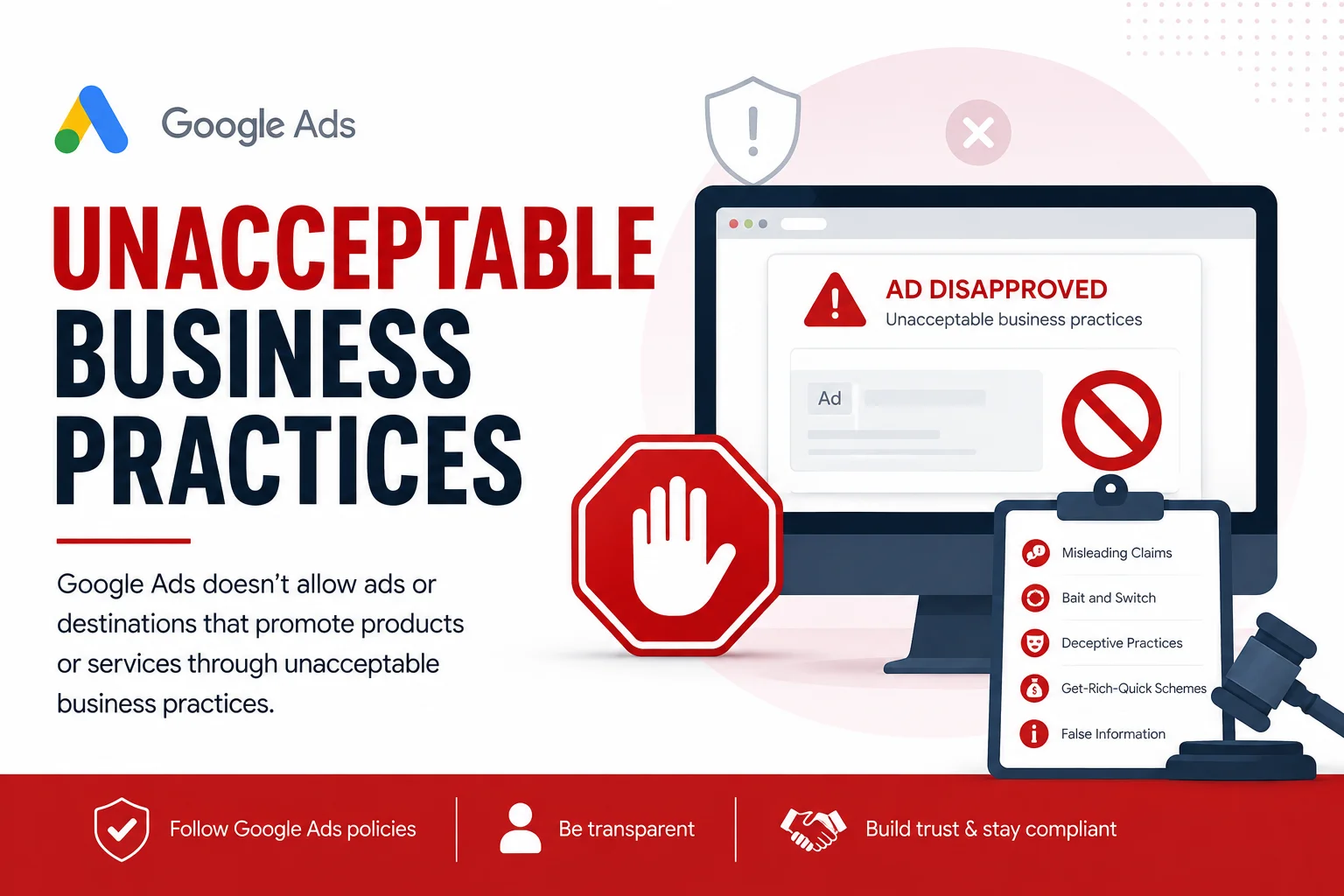
Did Google suspend your account for unacceptable business practices? You probably got no warning first. One day your campaigns ran normally. The next day, they disappeared — often for good.
That’s not random enforcement. Google officially classifies unacceptable business practices as an “egregious violation”. Egregious violations are either unlawful or pose real harm to users, so Google suspends the account the moment it detects one, without a warning stage. In many cases, Google won’t let you advertise again on that account at all.
That sounds harsh, and it is. But here’s what most guides on this topic miss: a large share of unacceptable business practices suspensions hit real, honest businesses. Scammers don’t cause most of them. Website transparency gaps, unclear franchise relationships, and marketing claims that were never meant to mislead anyone still trigger this policy.
This guide covers what the policy means in Google’s own words, why it catches compliant businesses so often, how to audit your website before you appeal, and what a strong appeal actually needs.
What Does “Unacceptable Business Practices” Mean on Google Ads?
Google created its unacceptable business practices policy to stop advertisers from scamming people. Specifically, it targets businesses that hide or misrepresent information about themselves, their products, or their services.
Google’s Official Definition
Under this policy, Google prohibits four things. You can’t:
- Imply an affiliation with another brand, organization, or government entity that doesn’t exist
- Offer products or services you can’t actually deliver, including operating without the right license or qualification
- Make health or safety claims that could put people at risk
- Impersonate other brands or businesses to collect money or personal information
Two details matter more than most articles mention. First, Google’s review doesn’t stop at your ad text — the policy states Google may pull information from your website, your accounts, and third-party sources when it decides whether a violation occurred. Second, because Google treats this as an egregious violation, it skips the warning stage that applies to many lower-severity issues.
Two Related Violations: Phishing and Impersonation
Google’s documentation groups two more violations under this same policy umbrella. Phishing means using a fake trusted identity to collect passwords, payment details, or other personal data. Public figure impersonation means falsely implying a celebrity, executive, or influencer endorses your product to trick people into buying or sharing information.

Why Google Flags Real Businesses for Unacceptable Business Practices
If you know you weren’t running a scam, you’re not alone. Most legitimate businesses that get caught fall into one of five situations.
Franchises and Multi-Location Brands
Google’s systems can flag a franchise location as an unverified third party using someone else’s brand — even when the franchise agreement is completely real. The relationship itself usually isn’t the problem. The problem is that Google’s review process has no way to see it.
Affiliates and Resellers
If you promote another company’s product without clearly labeling your relationship to it — “Authorized Retailer,” “Independent Consultant” — Google can read that as implied affiliation. That’s one of the exact behaviors this policy prohibits.
Regulated and Licensed Industries
Healthcare, legal, financial, and travel businesses get flagged disproportionately, because the policy specifically calls out health and safety claims and unlicensed services. If your website doesn’t visibly show your license or certification, Google’s review can’t confirm it exists.
Weak Website Trust Signals
A site with no About page, no clear physical presence, or inconsistent contact details can look like a scam to an automated system — even when nothing on it is technically false. The system simply can’t confirm the business is real.
Overselling Claims
Unsubstantiated guarantees, exaggerated results, and unverifiable testimonials are standard marketing practice on most websites. Under this policy, though, Google’s review reads them as potentially deceptive rather than persuasive.
We break down documentation requirements for each of these triggers — franchise proof, licensing disclosures, and more — in our full Unacceptable Business Practices recovery guide.

A Real Unacceptable Business Practices Case
One of our client cases shows this pattern clearly. Google suspended a multi-location salon franchise’s account for unacceptable business practices after flagging the location as an unverified third party using an established brand’s identity. Two earlier appeals had already failed. The franchise relationship was real, but the business had never documented it anywhere Google’s review could see.
The fix wasn’t a better-written appeal. The team sourced the actual franchise agreement ID, obtained a written authorization letter naming Google Ads specifically, and added a visible franchise disclosure to the landing page. Google reinstated the account 11 days after resubmission.
That same pattern — a real relationship that was never made visible — causes a large share of these suspensions. Read the full breakdown, plus two more anonymized cases, on our case studies page.
Self-Audit Checklist Before You Appeal an Unacceptable Business Practices Suspension
Appealing without fixing the real cause is the top reason a second appeal fails. Work through each area below first.
Business Identity and Transparency
- Does your site show your legal business name, physical address, and a working phone number or email?
- Do you have an About page that explains what your business actually does?
- Is your business information consistent across your website, your Google Ads account, and any public listings?
Licensing and Qualifications
- If your industry requires a license or certification, can visitors see it on your site — not just know you hold it privately?
- Is every certification you list still current?
Brand and Partnership Relationships
- If you’re a franchisee, authorized partner, or reseller, does your site explain that relationship clearly, not just imply it through shared branding?
- Do you have documentation ready — an agreement, a certificate, a public statement from the brand — in case an appeal needs it?
- Have you avoided using another brand’s name, logo, or colors in a way that could pass as the brand itself?
Claims, Pricing, and Testimonials
- Can you substantiate every specific claim on your landing page?
- Is your pricing clear and complete, without fees that only appear at checkout?
- Are your testimonials genuine and, ideally, verifiable?
Technical Trust Signals
- Does your site run on HTTPS?
- Are your Privacy Policy, Terms & Conditions, and Refund Policy (if relevant) present and accurate?
- Do your ads and landing page make the same promise? A mismatch is a common secondary flag.
If several of these apply to you, more than one issue is probably contributing to your suspension. That’s exactly why a single quick fix rarely works on the first retry. Our Unacceptable Business Practices recovery guide covers each fix in more depth.
How to Appeal an Unacceptable Business Practices Suspension
Google keeps its own appeal guidance short. According to the official policy page, you should follow the listed best practices before you appeal, not after. If you’re an official partner of another brand, explain that relationship in plain terms. Share proof — a contract, a written agreement, a credible news article, or a public statement from the brand. Complete advertiser verification if Google asks for it, since an unresolved verification request can block your appeal on its own.
A few practical additions consistently help beyond that official guidance:
- Fix every trigger, not just the one Google named. Google’s suspension notice usually names one general policy area, not the specific page that caused it. If a second issue stays live elsewhere on your site, your appeal can fail for a reason you never touched.
- Timestamp your changes. Screenshots or archive links showing when you made a fix prove it happened before you appealed, not after.
- Stay factual, not defensive. Google asks advertisers to be thorough, accurate, and honest. Appeals built on evidence tend to do better than appeals built on argument.
- Don’t open a new account while you wait. A second account during a suspension can create a fresh compliance problem on top of the original one.
For the full process we use with clients — account history, website audit, and appeal preparation together — see our Unacceptable Business Practices recovery guide or request a free account review.

Frequently Asked Questions About Unacceptable Business Practices
What counts as unacceptable business practices on Google Ads? Google’s policy covers scamming users by hiding or misrepresenting information about your business, products, or services. That includes false brand affiliation, offering services you can’t legally provide, risky health or safety claims, and impersonation to collect money or data. Phishing and public figure impersonation fall under the same policy.
Why did Google suspend my account with no warning? Google treats unacceptable business practices as an egregious violation. Its own policy documentation states that egregious violations get suspended on detection, skipping the warning stage many smaller issues go through first.
Can Google reinstate an account suspended for unacceptable business practices? Yes, often — but Google states it only reinstates accounts in compelling circumstances with good reason. A well-documented appeal that fixes the actual root cause has a much better chance than a generic resubmission.
Does my website matter if my ads look fine? Yes. Google’s review can pull from your website, your accounts, and third-party sources, not only your ad copy. A clean ad on a site with weak transparency can still contribute to a suspension.
I run a legitimate franchise — why did Google flag me? This is one of the most common honest triggers. If your relationship to a parent brand isn’t documented anywhere Google’s review can verify — a written authorization, a mention on the brand’s own site, a public statement — the system can’t tell you apart from an unauthorized third party.
Should I appeal again right away? Only after you review your entire website for every trigger this guide covers, not just the one issue you suspect. An appeal that doesn’t change anything substantive usually gets rejected again for the same reason.
How is this different from a Misrepresentation suspension? The two are closely related. Google’s Misrepresentation policy covers ads or landing pages that leave out relevant information or mislead users, and it sits alongside unacceptable business practices in the same trust-and-transparency enforcement family. The fixes overlap: clearer business information, accurate claims, and documented relationships.
Where can I read Google’s official policy myself? Go straight to Google’s Advertising Policies Help Center: the Unacceptable Business Practices policy, the related Misrepresentation policy, and the suspended accounts and appeals overview.
Official Google Sources on Unacceptable Business Practices
- Unacceptable Business Practices policy — Google Ads Advertising Policies Help
- Misrepresentation policy — Google Ads Advertising Policies Help
- Google Ads policies overview — Advertising Policies Help
- Suspended Google Ads accounts overview and appeals — Google Ads Help
- Appealing a policy decision — Advertising Policies Help
- Advertiser verification requirements — Advertising Policies Help
Get Help With Your Unacceptable Business Practices Suspension
An unacceptable business practices suspension is rarely about one bad ad. It’s usually about what your website and business information reveal — or hide — from Google’s review systems. Fixing the one thing you assume caused it, without checking the rest, is why so many appeals fail twice.
We review your account, your website, and your business documentation the same way Google’s own review does, before recommending your next step. Read our complete Unacceptable Business Practices recovery guide for the full walkthrough, or get a second opinion on your specific case.
Request a Free Account Review →
Written by Rohit Kumar, Google Ads Certified specialist and founder of AdsSuspensionRecovery.com. 8+ years of experience managing Google Ads accounts and suspension recovery cases across India and internationally.